
In this article
- When is scar revision a safe option for an old raised or uneven scar?
- What kind of raised scar do you actually have?
- What makes scar revision safer or riskier?
- What results are realistic, and what are the trade-offs?
- What does recovery look like if you have scar revision surgery abroad?
- How do cost, clinic choice, and surgeon credentials affect safety?
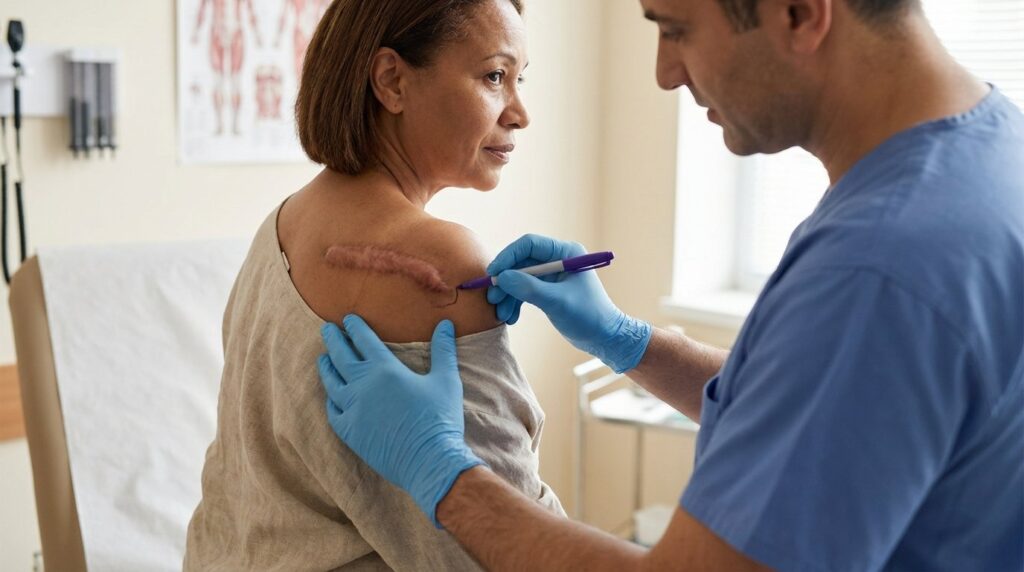
Many patients ask, is scar revision surgery safe for old scars that are raised or uneven, especially when the scar has been there for years and still feels tight, visible, or hard to cover. The short answer depends less on the scar’s age alone and more on the scar type, its location, your skin’s healing pattern, and whether the plan matches the problem.
When is scar revision a safe option for an old raised or uneven scar?
Scar revision can be a safe option for an older scar, but “old” does not automatically mean “easy.” In practice, surgeons look at whether the scar is mature, whether it is still changing, and whether it is raised because of thick healing, tension, or a tendency toward hypertrophic scars or keloids. A mature scar is usually less active than a newer one, which can make planning more predictable.
The biggest safety question is not simply whether the scar is old. It is whether surgery is the right tool for that exact scar. Some raised scars respond better to steroid injections, silicone therapy, pressure treatment, or laser work than to cutting the scar out. If the scar is uneven because it is widened, tethered, twisted, or sitting across a natural skin crease, surgical revision may help more than non-surgical options.
According to the NHS, cosmetic procedures should only be considered after you understand the risks, limits, and recovery involved. That matters with scar revision because the goal is usually improvement, not erasure. A safe plan is one that matches realistic expectations to the scar’s biology.
A scar that has been stable for a long time can be safer to revise than a newer scar that is still red, inflamed, itchy, or actively thickening. But if you have a personal or family history of keloids, or you formed a very raised scar after a small cut, piercing, acne lesion, or previous operation, surgery needs extra caution. In some patients, another incision can trigger another problematic scar.
If you are exploring treatment options, a formal scar revision consultation should cover more than appearance alone. The surgeon should ask how the scar formed, how long it has been stable, what treatments you already tried, and whether it causes pain, pulling, or restricted movement.
⚠️ Safe does not mean risk-free Scar revision can improve a scar, but it creates a new healing wound. The key question is whether the new scar is likely to heal better than the current one.
Stable scars, scars distorted by tension, widened scars, or scars that sit badly in a visible area often have clearer surgical indications.
Patients with a history of keloids, ongoing skin inflammation, poor wound healing, or uncontrolled medical conditions need more caution and sometimes a non-surgical first step.
What kind of raised scar do you actually have?
This is one of the most important parts of the safety discussion. Not every raised scar is the same, and the treatment plan changes a lot depending on the type.
Hypertrophic scars are raised scars that stay within the boundaries of the original wound. They can look thick, red, and firm, but they do not keep spreading beyond the original injury. Keloids behave differently. They grow beyond the wound edges and can keep enlarging over time. The 2018 Japan Scar Workshop Consensus, published in Burns & Trauma in 2019, highlighted that keloids and hypertrophic scars are distinct conditions and should not be managed as if they are identical.
That distinction matters because surgery alone may be a poor choice for a true keloid. Excision without a broader plan can lead to recurrence, sometimes with a scar that comes back as large as, or larger than, the first one. For that reason, many surgeons combine excision with other measures such as steroid injections, silicone therapy, pressure treatment, or, in selected cases, radiotherapy arranged through an appropriate specialist team.
Uneven scars also vary. Some are uneven because they are elevated. Others are indented, stuck to deeper tissue, or widened and shiny. A tethered scar that pulls when you smile, bend, or move may benefit from surgical release. A scar with colour change but little thickness may benefit more from laser or needling than from cutting it out.
Signs the diagnosis needs care
If a scar is itchy, painful, still growing, darker or thicker at the edges, or has come back after earlier treatment, that deserves a careful exam before surgery is booked. The surgeon may recommend waiting, treating inflammation first, or choosing a non-surgical option.
Patients with darker skin tones are not automatically poor candidates, but they do need a surgeon who is experienced with pigment change and raised-scar risk. The same 2018 Japan Scar Workshop Consensus, published in 2019, noted that some populations are more prone to problematic raised scarring, so the treatment plan should reflect that risk rather than ignore it.
- ✓Hypertrophic scar: raised but stays within the original wound
- ✓Keloid: grows beyond the original wound edges
- ✓Tethered scar: stuck down and pulls with movement
- ✓Widened scar: flat or slightly raised but spread out over time
What makes scar revision safer or riskier?
Safety depends on a mix of scar factors, patient factors, and surgeon planning. A small, mature scar on an area with low skin tension is very different from a thick chest scar in someone who has formed keloids before.
The location matters a lot. Scars on the chest, shoulders, jawline, and upper back can be more prone to raised healing because these areas are under tension. Scars over joints are harder too, because movement pulls on the wound while it heals. Facial scars often heal better than body scars because the blood supply is good, but visibility is higher, so small irregularities matter more.
Your own healing history matters just as much as the scar itself. Smoking, poorly controlled diabetes, immune problems, certain medications, active acne or skin disease near the scar, and nutritional problems can all affect wound healing. Mayo Clinic guidance on surgery recovery and wound healing principles supports the importance of general health, smoking avoidance, and proper follow-up in reducing complications.
Technique matters too. A thoughtful revision may involve changing the scar’s direction, releasing tension under the skin, layering the closure carefully, and adding non-surgical treatment after the procedure. A rushed “cut it out and stitch it up” approach is usually not enough for a difficult raised scar.
For patients travelling for care, timing matters. You need enough stay in Turkey for the early wound checks, dressing advice, and suture management if non-dissolving stitches are used. If you are comparing providers, look closely at the surgeon’s background on the doctors page and the clinic’s broader about page, then ask who will perform the operation, where it will take place, and who manages aftercare once you fly home.
🚨 A previous bad scar raises the stakes If you developed a keloid or severe raised scar after a minor wound before, tell the surgeon early. That history can change whether surgery is advised at all.
What results are realistic, and what are the trade-offs?
The most realistic aim is a scar that is flatter, softer, less tight, less uneven, or better placed so it draws less attention. Scar revision does not remove the body’s need to heal. It replaces one scar with another that, ideally, heals in a more favourable way.
That trade-off is worth it for many patients, especially when the scar is distorted, raised, wide, or functionally bothersome. But it is still a trade-off. The scar may improve in shape and texture while still remaining visible. Colour mismatch can also persist for months, sometimes longer.
Another point patients often miss is that scars can look worse before they look better. Early after revision, the line may be redder, firmer, and more noticeable than expected. That does not always mean something has gone wrong. Scar remodelling takes time.
The American Society of Plastic Surgeons explains that scar revision can improve cosmetic appearance or function, but it cannot completely erase a scar. That is the safest mindset to take into consultation. A good surgeon will be direct about the likely degree of improvement, the chance of recurrence in raised scars, and whether several treatments may be needed rather than one single procedure.
If a clinic promises a “scar-free” result or treats every raised scar as a simple excision case, that is a sign to slow down and ask harder questions.
Silicone gel or sheets, steroid injections, pressure therapy, laser treatment, and needling may be safer first-line options for some raised or uneven scars.
A staged plan is common, especially for thick scars, recurrent scars, or scars with both raised texture and colour change.
What does recovery look like if you have scar revision surgery abroad?
Recovery is usually manageable, but it is not identical for every scar. A small revision under local anaesthetic may involve light soreness, swelling, and a fine dressing for several days. A larger revision, or one combined with flap rearrangement to reposition the scar, may mean more swelling, longer activity limits, and a closer follow-up schedule.
The first phase is wound healing. During this period, the main goals are to protect the incision, reduce tension, and watch for bleeding, separation, infection, or unusual swelling. After that comes scar management, which can last much longer than people expect. Silicone, sun protection, tape support, massage, and sometimes steroid treatment may all be part of the plan.
If you are travelling for treatment, ask how long you should stay before flying home. The answer depends on the scar’s site, the size of the revision, and whether drains, dressings, or suture removal are involved. In general, you need enough time for an early check in person and clear instructions for the next phase once you return home. It is wise to arrange remote follow-up before you travel.
The table below gives a general idea of what patients often discuss with their surgeon. It is not a fixed timeline.
This article is for informational purposes only and does not constitute medical advice. Always consult a qualified surgeon for personalised guidance.
How do cost, clinic choice, and surgeon credentials affect safety?
With scar revision, the cheapest quote is not the same as the safest plan. Price is shaped by the scar’s size and location, whether treatment is surgical or combined with injections or laser, the setting used, the surgeon’s expertise, anaesthesia needs, and the amount of aftercare included. A proper quote should explain what is covered, such as consultation, facility fees, dressings, follow-up, and any planned add-on treatments.
For international patients, logistics are part of safety. Ask whether your first assessment can be done remotely, who reviews your photos, whether an in-person exam happens before the final surgical decision, and what support you have after you return home. If the scar is high risk for recurrence, your aftercare plan matters almost as much as the procedure itself.
Credentials also matter. Look for a surgeon with relevant plastic surgery training and a clear track record in scar management, not only in cosmetic operations more broadly. BAAPS and EBOPRAS are useful names to know when you are checking standards and specialist training pathways in Europe and the UK context. Even if you are travelling, the core questions stay the same: who is operating, what experience do they have with raised scars and keloids, and what happens if healing is not straightforward?
Use consultations to judge how carefully the team thinks. A safe clinic does not rush past your history, does not promise perfect removal, and does not avoid discussing recurrence. If you want to start that conversation, you can request a personalised review through the clinic’s consultation page.
Frequently Asked Questions
References
- 📎Diagnosis and Treatment of Keloids and Hypertrophic Scars—Japan Scar Workshop Consensus Document 2018 — Burns & Trauma, 2019
- 📎American Society of Plastic Surgeons: Cosmetic Procedures
- 📎NHS: Cosmetic Procedures
- 📎EBOPRAS
You Might Also Like



Our specialists
 Clineca SpecialistErkan PinegözPlastic & Reconstructive Surgery
 Clineca SpecialistHakan AktaşPlastic & Reconstructive Surgery
 Clineca SpecialistOrkun UzuneyüpoğluPlastic & Reconstructive Surgery
 Clineca SpecialistSalim İskenderPlastic & Reconstructive Surgery
 Clineca SpecialistEngin SelamioğluPlastic & Reconstructive Surgery
 Clineca SpecialistCem AydınPlastic & Reconstructive Surgery
 Clineca SpecialistAlperen ÖnalEar, Nose & Throat (ENT)