
Have a question about Breast Fat Injection?
In this article
If you are researching what to expect during breast fat transfer recovery in the first month, the main challenge is that recovery happens in two places at once: the breasts and the liposuction donor areas. That means the first few weeks can feel more like liposuction recovery than breast surgery recovery, even when the breasts themselves are only mildly sore. The details matter, because small choices about movement, pressure, travel, bras, and timing can affect both comfort and the way the result settles.
First-month recovery milestones at a glance
Recovery after breast fat transfer is usually manageable, but it is rarely identical from one patient to the next. Your timeline can shift depending on the surgeon’s technique, how much fat was transferred, how many donor areas were treated with liposuction, your general health, and how your body handles swelling. Final shape also does not settle in the first month; some of the early fullness drops as swelling improves, and fat survival becomes clearer over the following months.
In broad terms, the first several days are about swelling, soreness, and moving carefully. The second week is often the point when daily life feels easier, although bruising and firmness can still be obvious. By weeks three and four, many patients feel much more normal, but they may still have breast swelling, numb patches, and tenderness in liposuction areas.
The American Society of Plastic Surgeons explains that fat transfer uses liposuction to remove fat from one area and place it into another, so recovery reflects both parts of the procedure. Peer-reviewed literature in Plastic and Reconstructive Surgery and Aesthetic Surgery Journal also shows that graft take and final contour need time, which is why surgeons are cautious about judging results too early.
📋 Quick recovery picture Days 1-7 usually bring the most swelling, bruising, and tightness. Weeks 2-3 are often easier for walking, sitting, and light routines. By week 4, many patients feel improved but are still healing, especially in the liposuction areas.
⚠️ Red flags that need prompt medical advice Call your surgical team urgently if you develop sudden one-sided leg swelling, chest pain, shortness of breath, a fever, rapidly increasing breast swelling, worsening redness, foul drainage, or severe pain that is not improving.
- ✓Expect the donor sites to feel more bruised and sore than the breasts in many cases.
- ✓Early breast size is not the final result because swelling settles over time.
- ✓Compression is often used on the liposuction areas, but direct pressure on the breasts may be limited if your surgeon advises it.
- ✓Travel, exercise, and bra use should follow your own surgeon’s written plan.
What does the first week usually feel like?
The first week is often the most intense part of recovery, although “intense” does not always mean dramatic pain. Many patients describe soreness, heaviness, swelling, and a bruised feeling rather than sharp breast pain. The liposuction areas, such as the abdomen, flanks, or thighs, often feel tighter and more tender than the breasts.
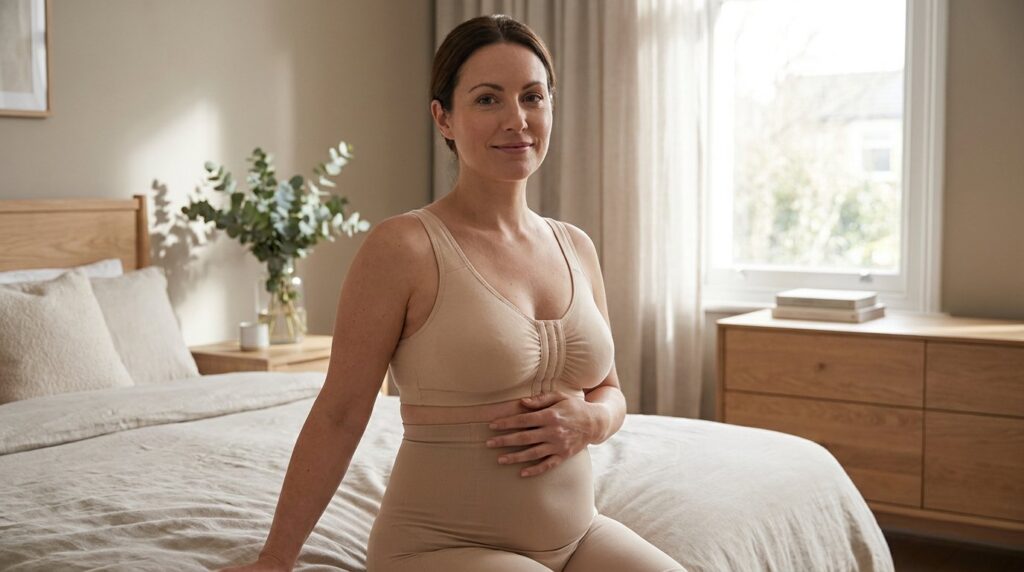
You may come home wearing compression on the donor sites. The breasts are often protected from pressure because newly transferred fat needs a good blood supply. That is one reason surgeons may advise sleeping on your back and avoiding tight bras or anything that compresses the chest directly unless specifically prescribed.
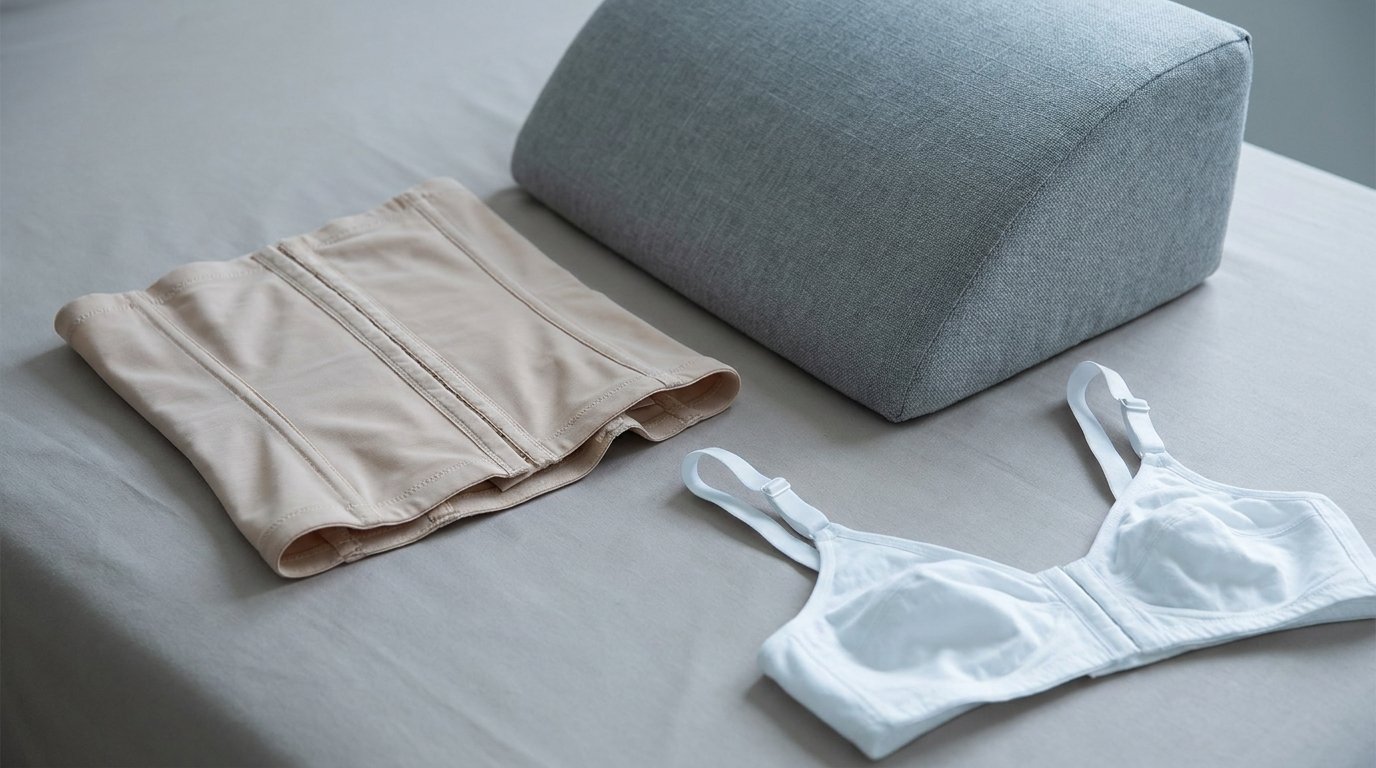
Drainage from the liposuction entry points can happen in the first day or two. This is usually a mix of fluid and a little blood, and it can look messy without meaning that anything is wrong. Bruising may spread or darken before it starts to fade. Swelling also tends to peak early, so the breasts can look fuller and firmer than they will later.
Walking matters from day one. The NHS and Mayo Clinic both stress the importance of early gentle movement after surgery to support circulation and reduce the risk of complications linked to immobility, including blood clots. That does not mean exercise. It means short, regular walks around your room or home, staying hydrated, and avoiding long periods completely still.
If you are planning surgery abroad, this is also the stage when practical support matters most. You usually need help with bags, reaching, and moving around comfortably. Even simple tasks become slower for a few days.
⚠️ Do not judge the result in week 1 Breast shape in the first week reflects swelling, fluid shifts, and tissue tightness. It is too early to know how much transferred fat will remain long term.
How does recovery change in weeks two to four?
The second week is often the turning point. You may still be swollen and bruised, but moving around usually gets easier. Many people need less pain medicine, stand more upright, and feel more comfortable doing desk-based tasks. That said, “better” does not mean fully recovered. The donor areas can remain firm, lumpy, numb, or tender, and the breasts may still feel swollen or oddly sensitive.
By week three, bruising often starts to fade more clearly. Breast swelling may go down unevenly, which can make one side seem ahead of the other for a while. Mild asymmetry during this stage is common and does not necessarily mean the final result will be uneven. Surgeons usually prefer to reassess symmetry only after more healing has happened.
Week four is often when patients start wondering whether the volume they see is the volume they will keep. That question is understandable, but the answer usually takes longer. Some of the early fullness is still swelling, and some transferred fat cells do not establish a lasting blood supply. This is why final results often take several months to show more reliably.
What often still feels normal at one month
At around one month, it can still be normal to have firm donor areas, small numb patches, tiredness by the end of the day, and breasts that feel fuller or heavier than expected. Small contour irregularities in liposuction zones may also soften gradually rather than disappearing all at once.
What should be improving, though, is the overall trend. Pain should be easing, mobility should be better, and swelling should not be suddenly increasing. If you feel you are moving backwards rather than forwards, that is the point to check in with your surgeon.
When can you shower, work, exercise, and fly?
These are some of the most important planning questions for international patients, and they need a personalised answer from your own surgeon. Timelines vary by graft volume, donor-site extent, whether you had other procedures at the same time, and your surgeon’s aftercare rules. A patient with small-volume transfer from one area may recover differently from someone who had larger-volume liposuction from multiple areas.
Showering is often allowed after a short initial period, once dressings and drainage are manageable, but your team must give the exact timing. Work depends on what you do. Desk work may be realistic sooner than work that involves lifting, long standing, or physical effort. Exercise returns in stages: walking first, then light activity, then more structured exercise only when your surgeon clears it.
Flying deserves extra thought. Long periods of immobility are one reason surgical teams are careful about travel timing after any operation. NHS guidance on reducing deep vein thrombosis risk highlights movement and avoiding prolonged stillness, and that becomes even more relevant on longer journeys. If you are travelling for surgery, your stay should be long enough for early checks and for your team to make sure you are fit to fly.
A practical health-tourism plan usually includes enough local recovery time for the first follow-up, access to advice if swelling changes suddenly, and help at the airport. It is also worth confirming how the clinic handles remote aftercare once you are back home, and whether you can contact the surgeon’s team easily if you send photos or have concerns.
For general background on the procedure itself, patients often compare breast fat transfer with breast augmentation options, but recovery rules should always come from the team performing your own surgery.
Includes local recovery days, a follow-up visit before departure, compression guidance, and a clear contact route for questions after you return home.
Assumes you can sightsee immediately, carry your own luggage, skip follow-up, or take a long flight without discussing clot risk and mobility advice.
What affects swelling, fat survival, and the final look?
Patients often focus on the breasts, but the final look depends on several moving parts. One is the technique used to process and place the fat. Another is how well the transferred fat develops a blood supply in its new location. Your own biology matters too, including circulation, smoking status, weight stability, and how your tissues heal.
Pressure matters in the early phase. Many surgeons try to reduce unnecessary compression on the breasts because it may affect the grafted fat. At the same time, donor areas are often compressed to help with swelling and contour support after liposuction. This can feel counterintuitive, which is why generic advice from friends or social media is often unhelpful.
Weight changes can also alter the result. Transferred fat behaves like fat elsewhere in the body, so significant weight loss after surgery may reduce volume. Weight gain can enlarge the area. That is one reason surgeons usually prefer patients to be at a stable, realistic weight before surgery.
You should also expect some uncertainty in retention. Peer-reviewed studies in journals such as Aesthetic Plastic Surgery and Plastic and Reconstructive Surgery discuss variable fat graft survival, which is why touch-up treatment is sometimes considered later. That does not mean something has gone wrong. It means fat grafting is a living-tissue procedure, not a fixed implant volume.
📋 Why final results take time At one month, swelling may still be present and long-term fat retention is not fully clear. A more reliable view of shape and volume usually takes several months.
How do you choose a safe clinic and understand the quote?
Safety starts before the operation. You want a surgeon who is properly qualified in plastic surgery, works in an accredited hospital or clinic, and gives written aftercare instructions that make sense for an international patient. Bodies such as EBOPRAS and BAAPS are useful points of reference when checking training standards and professional background.
A good consultation should cover your goals, whether you have enough donor fat, what shape change is realistic, what scars to expect from liposuction access points, and how aftercare will work once you are home. It should also include a direct conversation about smoking, clot risk, medicines, previous breast issues, and whether imaging or breast screening advice is relevant in your case.
On price, the most useful question is not “what is the cheapest option?” but “what exactly is included?” A personalised quote is usually confirmed after consultation and often reflects the surgeon’s experience, the facility, anaesthesia, the extent of liposuction, garments, medicines, hotel or transfer arrangements if relevant, and follow-up care. Comparing quotes only by headline figure can hide important differences in safety, aftercare, and what happens if you need extra review.
If you are at the stage of comparing providers, it is more useful to review the surgeon profile, the hospital setting, and the follow-up plan than to focus on marketing language. Patients who want to ask about suitability can use a formal consultation request, but the key point is to get clear clinical answers rather than a sales pitch.
- →Good sign: The team explains limits and uncertainty, including the fact that some transferred fat may not remain long term.
- →Caution sign: You are given a fixed promise about cup size, zero downtime, or an unusually rushed travel plan.
- →Good sign: You receive written advice on bras, sleeping, flying, activity, and when to seek urgent help.
- →Caution sign: Questions about surgeon credentials or complication planning are brushed aside.
Frequently Asked Questions
References
- 📎American Society of Plastic Surgeons: Cosmetic Procedures
- 📎NHS: Cosmetic procedures
- 📎Mayo Clinic: Tests and procedures
- 📎PubMed search: breast fat grafting recovery fat graft survival liposuction donor site
Related Articles

You Might Also Like


Related articles
Our specialists
 Clineca SpecialistErkan PinegözPlastic & Reconstructive Surgery
 Clineca SpecialistHakan AktaşPlastic & Reconstructive Surgery
 Clineca SpecialistOrkun UzuneyüpoğluPlastic & Reconstructive Surgery
 Clineca SpecialistSalim İskenderPlastic & Reconstructive Surgery
 Clineca SpecialistEngin SelamioğluPlastic & Reconstructive Surgery
 Clineca SpecialistCem AydınPlastic & Reconstructive Surgery
 Clineca SpecialistAlperen ÖnalEar, Nose & Throat (ENT)